Thursday, 16 January 2025

Leopard hunting jackal for 12 minutes, uncut single shot


Following on from my last YouTube video, which you should check out after this, of the leopard hunting the jackal I've decided to show the whole process of the stalk. It was such an incredible moment watching the leopard slowly sneak up on the sleeping jackal, not losing focus for the entire 12 minutes. The rest shows the effort the leopard went to to store the jackal in the tree. If you watch my previous video you will see the jackal escapes. But I'd stopped filming and restarted for that. I wanted to show the entire uncut single shot sequence. Enjoy.

Wednesday, 27 May 2020

Camera Trapping Again

I've set up the camera trap in the garden. So far, aside from cats, we have this fox. I'll upload more when I see more. 


Sunday, 24 April 2016

Edge of the Desert Novel

My latest book, an African novel, is now available to buy.

Click below to preview Edge of the Desert.

Available to buy in UK:
from amazon in paperback or on kindle

Or US
from amazon in paperback or on kindle

Also available on all other amazon stores


Saturday, 5 March 2016

Available Now: A Zoologist's Stumblings In Africa: How to Habituate a Bonobo

Its finally ready! My book is now available to buy in paperback, kindle and non-kindle ebook. Here is the link to the uk amazon paperback and kindle. http://amzn.to/1RtijVK
It should be on all the other amazon country sites too.


Paperback:
Amazon (UK)
Amazon (USA)
Amazon for other territories: DEFRESIT
Createspace (USA)


Ebook:
Kindle (UK)
Kindle (US)
Kindle for other territories: DEFRESITNLJPBRCAMXAUIN
Kobo
Smashwords
Scribd
Inktera
iBooks


"Enter Lui-Kotale in the Democratic Republic of Congo and meet some amazing primates, the bonobos. Get to know the least know great apes at a personal level as well as many other species and people. From bonobos in the day to leopards in the night being a bonobo habituator is far from dull. During nine months following a wild group of bonobo, meat eating, wading and urinating on researchers, were some of the many amazing things these apes did. There were also the elephants, driver ants, snakes, poachers and local villagers to deal with. This is the side of Africa's dark heart you have never seen before, the warm heart."

20% of proceeds will go to bonoboalive to help protect wild bonobos.

Sunday, 14 February 2016

Thursday, 24 December 2015

Expedition Films

I have been on a few trips since last updating here. Congo, Mauritius and Gabon. I have made several videos and have more to upload. You can keep up to date on my youtube channel https://www.youtube.com/channel/UCTMWs4VA6DJu4REJUqp0ATw
Here is a sample of the videos on my channel. Loango in Gabon. I hope you pay a visit to my channel to see more.


Friday, 1 February 2013

New Job in the Heart of Africa

I don't know why I haven't posted about this, probably because I have been busy preparing for my next African adventure. I am off to a country that I have not been to and not many tourists either. I am off to the Heart of Africa, the Democratic Republic of Congo with my new job. I am going to be a bonobo researcher for 9 months.
After flying into the country I take a small plane into the interior then hike 25km across savanna, swamp, rivers and rainforest to reach a remote camp in the middle of the dense rain forest. One there I will not leave the rainforest for 9 months.
I found out just days ago and leave in 2 weeks so its all rush. For those who dont know what a bonobo is think pygmy chimpanzee and you get the idea.

A bonobo

Saturday, 26 January 2013

Rhinos at the Picnic


The drive ended at a vlei or waterhole with a meal of salad and apples. I enjoyed the salad, which is very odd for me who likes to have some form of meat in a meal. It was probably due to the location than the actual food though. The vlei was located in the middle of a large plain a few kilometers wide encompassed by towering cliff faces on all sides of sandstone and limestone creating a mini crater. The center of the plain contained a depression of a almost circular bowl around 100m across which is where our vlei sat.
Enjoying our picnic
We left our trusty landrover on the road behind a bush some 50m from the vlei and headed to the waters edge. Our “guides” for the evening served up the food from a small pop up table on the waters edge where we sat eating and listening to the calls of frogs just waking from there slumber to begin the deafening night chorus. From the aptly named babbling kassina’s who sound like a bubbling water to the pain inducing pierce of the painted reed frogs we had them all.
Once everyone had polished off there first helpings and collected there seconds or an apple we gathered round the table to debrief and give feedback to the afternoons guide and tracker before handing over to me for my first night drive and my tracker. It was a normal feedback session with the standard comments of “ The drive was a bit bumpy” or “Make sure you know what the species we are looking at is”. These can be of great importance and help you to develop your guiding skills if they are not taken too personally which unfortunately for some they did.
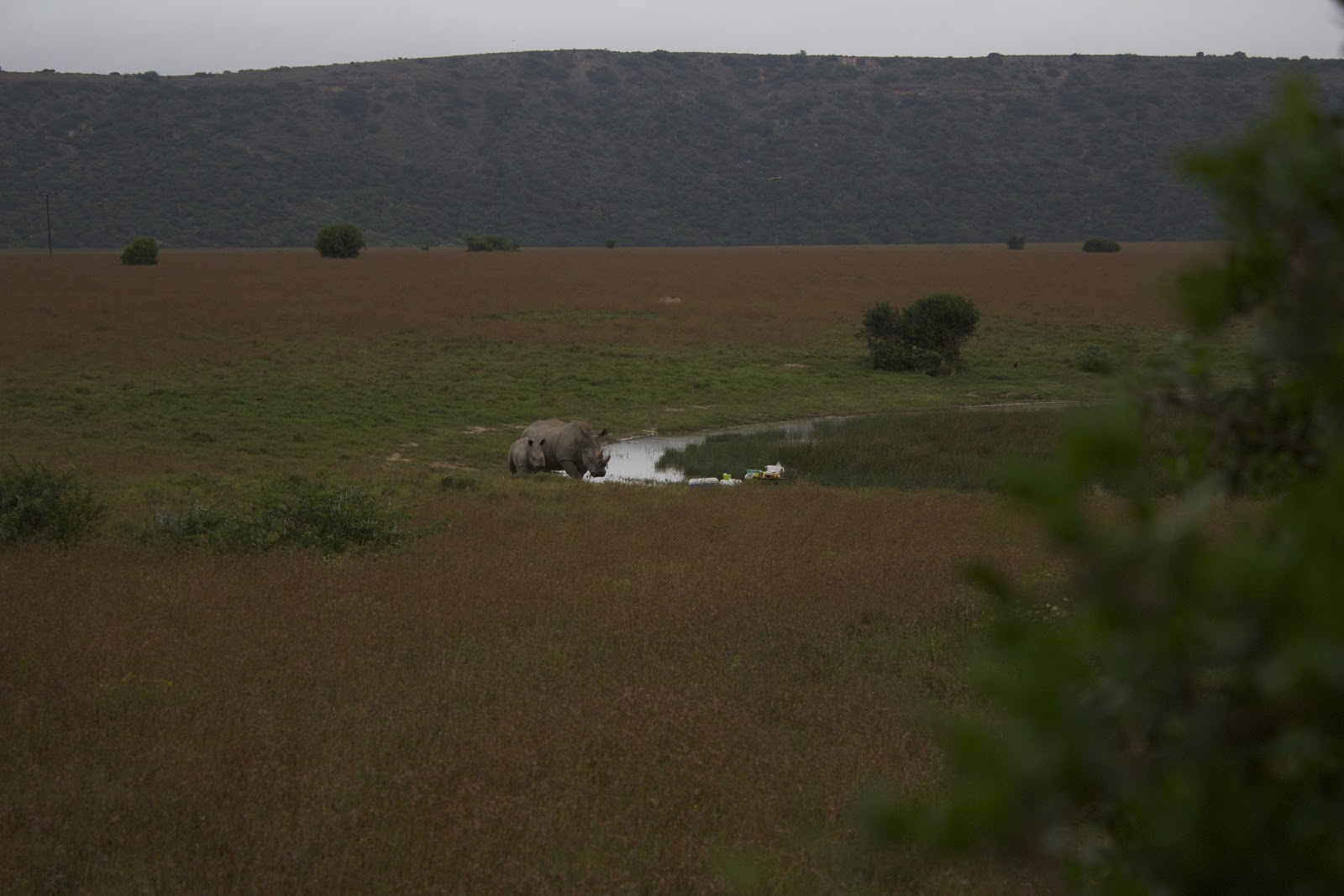
After I had said my piece I felt an urge to look around before the last of the light faded. Coming over the rim of the small bowl containing the vlei not 20m away from us was a female white rhino and calf. We where in the open with the safety of the vehicle in the direction of the rhino. As calmly as possible I casually said “Rhino” so as not to panic everyone. I am sure they thought I was on about the rhino sighting from the drive and about to give feedback. It didnt sink in so I pointed to the rhino slowly plodding along directly to where we stood.

Rhino approaching our picnic
Rhino have very poor eyesight but extremely good hearing and smell. Lucky for us in the fading light its vision was greatly reduced even more and the wind was in our favour. Being in the bowl next to the frogs steadily increasing calls our talking was lost in the croaks and rattles. Once everyone was aware of the very close mother and calf we dropped everything and slowly moved off. Walking rather than running is a golden rule with wildlife but feels wrong especially as what you are trying to escape is keeping pace.We circled out away from them and around to the safety of the vehicle. Wesley stopped to take photos to which Mike wisely made him put down the camera and keep walking.
After spotting the table
We made it safely up the slope, around the bushes and back to our trusty landrover, Eleanor. The rhinos walked casually towards the exact spot we had just been sitting. The had not even known we had been there and was only when she basically bumped into the picnic table they she became aware of our presence. She panicked, jumped back and the two took flight over the far rim of the bowl while we watched from behind the bush in Eleanor. Once they had disappeared from view we returned to our picnic, finished the last of the food and packed it all into Eleanor. We then got back on with our plan of looking for frogs in the dark.


Off they go


The mothers print


Monday, 21 January 2013

Im a Field Guide!

I have just received my results from FGASA and achieved 92%! Thank you everyone at Ulovane. If anyone is thinking of doing a field guide course I fully recommend them. Go here (link).

Anyone looking for a field guide I have level 1 and a BSc (Hons) in applied zoology.

Newly qualified field guide (not the caracal)

Sunday, 13 January 2013

My Ultimate Capture

I have had this video in my collection since September but being at Ulovane I never got around to actually using it on a post which is strange as it shows the animal which I most want to see in the wild. When I was checking through the videos with my family after collecting it in Blue Hills I nearly dropped my drink. I was extremely excited and had to put my drink down before watching it again. 

It is a shot of that elusive creature, the honey badger. And not just one but two!


After watching it is obvious that the second one is a youngster and it is following its mother. You can see the youngster check the camera out before realising its mother has just carried and runs off in pursuit. Young honey badgers may stay with the parents for over 2 years and since this guy is pretty big he cannot be far off leaving. 

During my whole time out there I never once saw the honey badger. I captured this video, seen damage they had done to a bee hive a few days before and on a morning walk during tracker duties at Shamwari there where fresh honey badger prints on the road out of camp. I have come so close so many times but I will not give up my search. I will return to find the honey badger.

Wednesday, 26 December 2012

A Cheetah Wakes Me Up


Sleep outs where a highlight of the course for me and our last one was the one I will remember the most.
Our last practice drive turned out to be one of the best so far. We headed out with a plan to focus on mammals and animal behaviour but since it was also birding big day and the only half the group that came where the birders we also tried to get over 100 birds in a day. We had a very successful day spotting 110 birds by the time we went to bed. The 100th bird was a special, an amethyst sunbird, only the second we have seen here so far. A few days later we learnt that we had set an Amakhala record beating the previous record of 104 birds in a day which made us all proud.                                                                                                               


       As it was the last group sleep out we looked for a special place to stay and we settled on a camp site in amongst the thicket with close enclosed borders but very open and spacious inside. It was like it had been built for us by nature with black backed weavers and green wood hoopoe nesting in the trees and a spongy ground covering of soft leaves and grass. Since the rhino, buffalo and elephant where in the area we blocked all entrances off with branches, not to stop the animals but to give us a warning. As such we had to be very vigilant on night shift because of the close proximity of big game. Fortunately we had no visitors durning the night except for an inquisitive barn owl. As dawn broke we all woke to listen to the bird calls of the dawn chorus and ate breakfast. Since night shifts had been so intense we all had a 2 hour sleep and since it was daylight no-one stayed on watch.
The cheetah who said hello
After a sleep I woke to a rustling in the thicket nearby. Everyone else was fast asleep in the middle of the thicket. I slowly lifted my head to check what the sound was and I saw a male cheetah had entered camp and was 5m way from my roll mat! My first thought was “Leopard!, oh no its just a cheetah.......It’s a cheetah!”. I tried to get the attention of Mike, our facilitator, in the most silent way possible by whispering as loud as I could. Mike sat up quickly wondering what was going on and as he did the cheetah saw us, took fright and bounded off through the trees. I don't know who was more scared, us or the cheetah. For the next half hour Mike and I could not stop laughing and returning to sleep was out of the question for us.

Wednesday, 19 December 2012

I'm Back

So I have not updated here for a long time and the reason is I have been way too busy. Since my last post way back in September I have been at Ulovane training to be a field guide. I was so busy revising, learning to guide, sleeping in the bush and jumping off stuff that this blog had to take a rest.
Now with being back on Pudding Island I have time to update here and I am going to tell you all about my adventures. From having a picnic interrupted by rhino to a cheetah in camp and many other adventures too.
So to get you interested I will start with the end. Our graduation video. This shows some of the fun times we had and some of the wildlife we saw. I hope you enjoy and check back soon for some tales from the bush.


Thursday, 20 September 2012

Flower Power

Its flower season in the Western Cape and there is nowhere better to see this display that on the west coast and in particular Postberg within the West Coast National Park.  I know this park quite well having spent some time 2 years ago with the field rangers. I returned last week to see the part of the park only open during flower season, Postberg. This part of the park is privately owned but part of the park. It also houses many large endangered mammals such as bontebok, black wildebeest and cape mountain zebra. It is great to see them amongst the stunning flowers on a sunny day. The flowers stay closed on overcast days.

A down side of the flowers is the amount of people rushing through the rest of the park to get to Postberg which lies at the end of a peninsular. I was overtaken by people who must have been doing over 100km/h when the speed limit is 50km/h. I rarely got over 30km/h and was overtaken by so many people, embarrassingly very old people who sit with there head on the windscreen and chairs as far forward as they can go. This resulted in many dead animals. I saw a few mongoose, birds tortoise and a snake all hit by cars. The people also missed out many great sightings. I alone saw the humpback whale playing in the surf outside of Postberg and the black harrier flying along the road.

However it is worth a visit but drive slowly, there is more to see than just the flowers here.

Black headed heron in the flowers

The black harrier no one wanted to see

Bontebok enjoying the flowers 
Black wildebeest int purple

Myriad colours

Flowered Plain

Ostrich in the flowers


Sunday, 16 September 2012

Snake by the Pool

I am currently in Langebaan on the West Coast and the flowers are still amazing and colourful, and I still need to do a post on them. But today I saw something to override the flower post. A beautiful snake. 

When I first came to Langebaan in 2009 I was exploring the garden when I saw a Cape cobra by the pool. We eventually captured the deadly snake and released him by the national park. Now every time I go by the pool I take a cautious look around the corner first.

Today I was greeted by a snake. My first thoughts where the snake had finally made its way home after 3 years. But no this was no cobra. In fact I am not 100% sure what it is. I checked up in the snake book on the shelf and seems to me it is a juvenile mole snake. The book only showed an adult but the description of a juvenile fits as does its range. 

Mole Snake?

Maybe a juvenile?
Anyway after taking a few photos it spotted me. It curled up into an aggressive pose much like an adder will. The book said it can be aggressive but is not venomous. I did not know this at the time and it came after me. I retreated a bit before it gave up the chase and disappeared into a hole in the ground. Hopefully he will return so I can get a better look at him.

If anyone can positively identify the snake please let me know in the comments below.

Tuesday, 11 September 2012

3D Francolin

A while ago on my other blog i posted some 3D images that dont require glasses (link). Today while in the west coast national park looking at the amazing flowers, (which will be in a future post) I took a few photos of this francolin. I noticed two where very similar and thought I would see what would happen if i tried to apply the 3D effect. It seems to have worked to a degree. Let me know what you think.


Thursday, 6 September 2012

An Ant-Bear

So a few weeks ago I captured footage of a cape mountain leopard. On the camera there was also another interesting individual, the aardvark or ant-bear. This gut was in the same location as the leopard, just a week later. The area seems to be a busy place so I have returned my camera there to try and capture my number 1 animal, the ratel or honey badger. 

The aardvark wondered around in the distance in this first video probably looking for its favourite food, termites. The aardvark tears a termite mound apart with its sharp claws and then has easy access to the little guys inside. 


The next video shows the strange animal much closer. If you refer back to my post on the leopard (link) you can compare the sizes of the two animals as they both stand in the same location. 


The termite mounds all around the area are filled with large holes created by these guys but smaller holes just a few mm wide are scattered all over the mounds. These give the mounds a pitted appearance and are made by another creature not termites or aardvark. These are made by the ground woodpecker. They use their bills to poke about inside the mound and pick out some juicy termites.

Ground Woodpecker

Friday, 31 August 2012

Hopper


Today after kayaking (and falling in) I spent the heat of the day on a riverbank reading a good Durrell book. I sat in the shade of a tree with the water lapping gently at the bank beneath my feet. It was all very pleasant. The birds had stopped singing with the heat and all was calm. The only things moving where the grass hoppers. They would scatter at any movement from me such as turning a page to see what Gerry was up to.


       Then one ginormous grasshopper made himself present. He for some reason could not or would not jump or fly away. He would walk around seeing what I was up to. He held my attention and so I placed him on a stick in the bushes for two reasons. First I liked this hopper and didn't want him eaten up due to his reluctance to fly. And secondly he was a good subject to photo on a stick. I took my photos and left him to enjoy the sun.


Wednesday, 29 August 2012

Monkeys!

So as I make my way round the coast up into KwaZulu Natal the climate is noticeably different. It is very hot and humid. A walk on the beach at 8am had my sweating from the humidity. Its a little different to the drier (except for the floods) and hot Western Cape. The wildlife is different too. Birds are popping up which I am unable to identify as my guide book is up in the Blue Hill. Monkeys are become more common too. They are in parts of the Western Cape but here they are everywhere. 

The monkey species I am seeing are the vervet monkeys and are very playful. Below are just a few that I spotted in peoples gardens around Port Shepstone. They are not afraid of humans here so I was able to get quite close. Thankfully they are not as vicious as the baboons either.

Popping out the hedge

Meditating 
Keeping an eye on me

Monday, 27 August 2012

Of Dodos and Coelacanth


East London has been a place I wanted to visit for a while due the history behind the discovery of the coelacanth, a fish thought to be extinct for over 70 million years. Imagine the surprise when one was caught off East London in December of 1938. It is like finding dinosaurs are not extinct.  The fish was put on display and on the first day of showing over 1000 visitors saw the exhibit. I went to see the fish and also the worlds only dodo egg.


Original sketches from the discovery.

So I went to the museum heading straight for the natural history section finding a whole room dedicated to the coelacanth. I keep myself from looking at the specimen in the center of the room and instead read all the signs and saw the original drawings of the specimen. When I could no longer hold my excitement I headed to the center of the room and wow! It was preserved amazingly. I have seen a coelacanth in London and Cape town natural history museums but they where white and faded, only just recognisable as the fish. But this one was preserved amazingly. I stayed looking at the specimen for at least 10 minutes before searching for the other item which had drawn me in, the dodo egg.

The coelacanth
Imagine my disappointment then when the egg on display was just a replica. The original is kept locked away behind the scenes. I then decided to use my newly acquired qualification and a bit of truth stretching by saying I was a zoologist from the U.K and had come to East London specifically to see the egg (which was true it was why I came to East London, but I made it sound as if I had come all the way from the U.K just to see it). After a bit of thought the receptionist called one of the behind the scenes team who where only too happy to show me the egg and much more.

I was taken behind the locked doors and told to wait while the egg was fetched from a locked room. Then all security measures where forgotten and I was able to see the egg for as long as I wanted and snap some photos. I was told the history of the item too.

Coelacanth (head cut away to see skull)
A few people doubt its a dodo egg and just an irregular ostrich egg. The previous curator Miss Courtenay Latimer, who also first saw the coelacanth after a fisherman brought it into the museum (and who the latin name is also honoring) was in possession of the egg from her great aunt, Lavinia Bean. She herself got the egg from her father, Mr L.O Bean who got it from a friend, Captain van Syker. The captain got the egg as payment for a debt from a man from Mauritius, the Dodos home island. The man supposedly had two eggs but only paid with one. The other eggs whereabouts is unknown.

Incidentally Lee Durrell, Gerald Durrell’s widow, saw the egg and told the staff that while in Russia they had heard about two dodo eggs which where in existence. Ones whereabouts was unknown probably in a private collection in Russia. The other however was traded as payment for a ferry ticket the owner couldn't afford, in Mauritius. This ties in nicely supporting the story of how the museum got the egg.

The dodo egg
The egg cannot be confirmed as dodo until the owners, the descendants of miss Latimer, who are loaning it to the museum allow a DNA test. I believe it to be dodo as do most people. There is plenty more information out there to why it is likely to be a dodo egg not an ostrich.

Lastly I was shown footprints made by early homo sapiens which are the oldest in the world out dating Eve from Langebaan by 7,000 years! These new prints are believed, from tests, to be 124,000 years old. They where found in the dunes 5km from East London and the originals are on display in the museum, not casts. The staff where very nice and I would like to thank them for allowing me this rare glimpse.

This is a long post as I was impressed and wanted to get that across and give some information I gathered to you. No idea as yet what the next post will be on but keep an eye on here as I am heading North now towards Durban and new territory for me so plenty of exploring.


Friday, 24 August 2012

Def(initely) Leopard


So in my last post was a film about setting up a camera trap and included some footage of a leopard. The leopard stayed around for three films. I think it is a male from the shape of the head and the muscular form. It is most likely one of the resident males, Big Boy. The other male, Butch, has a radio collar on his neck so it is definitely not him.  The video I like most is when he sniffs the camera trying to work out what it is.


The other he walks past still checking out the camera.


In the third he is a bit more difficult to spot as he lies in the grass after scent marking. You can see his eye shine towards the end.


It is great to know that the leopards are still holding on in the mountains of the western cape even if it is just a small number. Figures suggest there could be fewer than 20 left in the Baviaanskloof Mega reserve which borders Blue Hill Escape where this footage was captured. Lets hope they hang on and increase in numbers.