Showing posts with label Nature. Show all posts

Thursday, 20 September 2012

Flower Power

Its flower season in the Western Cape and there is nowhere better to see this display that on the west coast and in particular Postberg within the West Coast National Park.  I know this park quite well having spent some time 2 years ago with the field rangers. I returned last week to see the part of the park only open during flower season, Postberg. This part of the park is privately owned but part of the park. It also houses many large endangered mammals such as bontebok, black wildebeest and cape mountain zebra. It is great to see them amongst the stunning flowers on a sunny day. The flowers stay closed on overcast days.

A down side of the flowers is the amount of people rushing through the rest of the park to get to Postberg which lies at the end of a peninsular. I was overtaken by people who must have been doing over 100km/h when the speed limit is 50km/h. I rarely got over 30km/h and was overtaken by so many people, embarrassingly very old people who sit with there head on the windscreen and chairs as far forward as they can go. This resulted in many dead animals. I saw a few mongoose, birds tortoise and a snake all hit by cars. The people also missed out many great sightings. I alone saw the humpback whale playing in the surf outside of Postberg and the black harrier flying along the road.

However it is worth a visit but drive slowly, there is more to see than just the flowers here.

Black headed heron in the flowers

The black harrier no one wanted to see

Bontebok enjoying the flowers 
Black wildebeest int purple

Myriad colours

Flowered Plain

Ostrich in the flowers


Sunday, 16 September 2012

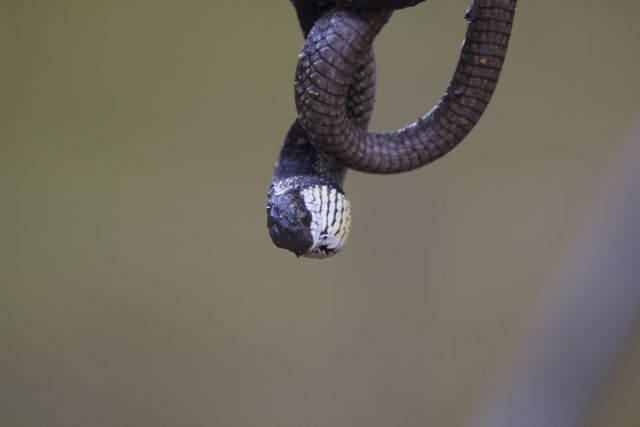
Snake by the Pool

I am currently in Langebaan on the West Coast and the flowers are still amazing and colourful, and I still need to do a post on them. But today I saw something to override the flower post. A beautiful snake. 

When I first came to Langebaan in 2009 I was exploring the garden when I saw a Cape cobra by the pool. We eventually captured the deadly snake and released him by the national park. Now every time I go by the pool I take a cautious look around the corner first.

Today I was greeted by a snake. My first thoughts where the snake had finally made its way home after 3 years. But no this was no cobra. In fact I am not 100% sure what it is. I checked up in the snake book on the shelf and seems to me it is a juvenile mole snake. The book only showed an adult but the description of a juvenile fits as does its range. 

Mole Snake?

Maybe a juvenile?
Anyway after taking a few photos it spotted me. It curled up into an aggressive pose much like an adder will. The book said it can be aggressive but is not venomous. I did not know this at the time and it came after me. I retreated a bit before it gave up the chase and disappeared into a hole in the ground. Hopefully he will return so I can get a better look at him.

If anyone can positively identify the snake please let me know in the comments below.

Tuesday, 11 September 2012

3D Francolin

A while ago on my other blog i posted some 3D images that dont require glasses (link). Today while in the west coast national park looking at the amazing flowers, (which will be in a future post) I took a few photos of this francolin. I noticed two where very similar and thought I would see what would happen if i tried to apply the 3D effect. It seems to have worked to a degree. Let me know what you think.


Thursday, 6 September 2012

An Ant-Bear

So a few weeks ago I captured footage of a cape mountain leopard. On the camera there was also another interesting individual, the aardvark or ant-bear. This gut was in the same location as the leopard, just a week later. The area seems to be a busy place so I have returned my camera there to try and capture my number 1 animal, the ratel or honey badger. 

The aardvark wondered around in the distance in this first video probably looking for its favourite food, termites. The aardvark tears a termite mound apart with its sharp claws and then has easy access to the little guys inside. 


The next video shows the strange animal much closer. If you refer back to my post on the leopard (link) you can compare the sizes of the two animals as they both stand in the same location. 


The termite mounds all around the area are filled with large holes created by these guys but smaller holes just a few mm wide are scattered all over the mounds. These give the mounds a pitted appearance and are made by another creature not termites or aardvark. These are made by the ground woodpecker. They use their bills to poke about inside the mound and pick out some juicy termites.

Ground Woodpecker

Wednesday, 29 August 2012

Monkeys!

So as I make my way round the coast up into KwaZulu Natal the climate is noticeably different. It is very hot and humid. A walk on the beach at 8am had my sweating from the humidity. Its a little different to the drier (except for the floods) and hot Western Cape. The wildlife is different too. Birds are popping up which I am unable to identify as my guide book is up in the Blue Hill. Monkeys are become more common too. They are in parts of the Western Cape but here they are everywhere. 

The monkey species I am seeing are the vervet monkeys and are very playful. Below are just a few that I spotted in peoples gardens around Port Shepstone. They are not afraid of humans here so I was able to get quite close. Thankfully they are not as vicious as the baboons either.

Popping out the hedge

Meditating 
Keeping an eye on me

Monday, 27 August 2012

Of Dodos and Coelacanth


East London has been a place I wanted to visit for a while due the history behind the discovery of the coelacanth, a fish thought to be extinct for over 70 million years. Imagine the surprise when one was caught off East London in December of 1938. It is like finding dinosaurs are not extinct.  The fish was put on display and on the first day of showing over 1000 visitors saw the exhibit. I went to see the fish and also the worlds only dodo egg.


Original sketches from the discovery.

So I went to the museum heading straight for the natural history section finding a whole room dedicated to the coelacanth. I keep myself from looking at the specimen in the center of the room and instead read all the signs and saw the original drawings of the specimen. When I could no longer hold my excitement I headed to the center of the room and wow! It was preserved amazingly. I have seen a coelacanth in London and Cape town natural history museums but they where white and faded, only just recognisable as the fish. But this one was preserved amazingly. I stayed looking at the specimen for at least 10 minutes before searching for the other item which had drawn me in, the dodo egg.

The coelacanth
Imagine my disappointment then when the egg on display was just a replica. The original is kept locked away behind the scenes. I then decided to use my newly acquired qualification and a bit of truth stretching by saying I was a zoologist from the U.K and had come to East London specifically to see the egg (which was true it was why I came to East London, but I made it sound as if I had come all the way from the U.K just to see it). After a bit of thought the receptionist called one of the behind the scenes team who where only too happy to show me the egg and much more.

I was taken behind the locked doors and told to wait while the egg was fetched from a locked room. Then all security measures where forgotten and I was able to see the egg for as long as I wanted and snap some photos. I was told the history of the item too.

Coelacanth (head cut away to see skull)
A few people doubt its a dodo egg and just an irregular ostrich egg. The previous curator Miss Courtenay Latimer, who also first saw the coelacanth after a fisherman brought it into the museum (and who the latin name is also honoring) was in possession of the egg from her great aunt, Lavinia Bean. She herself got the egg from her father, Mr L.O Bean who got it from a friend, Captain van Syker. The captain got the egg as payment for a debt from a man from Mauritius, the Dodos home island. The man supposedly had two eggs but only paid with one. The other eggs whereabouts is unknown.

Incidentally Lee Durrell, Gerald Durrell’s widow, saw the egg and told the staff that while in Russia they had heard about two dodo eggs which where in existence. Ones whereabouts was unknown probably in a private collection in Russia. The other however was traded as payment for a ferry ticket the owner couldn't afford, in Mauritius. This ties in nicely supporting the story of how the museum got the egg.

The dodo egg
The egg cannot be confirmed as dodo until the owners, the descendants of miss Latimer, who are loaning it to the museum allow a DNA test. I believe it to be dodo as do most people. There is plenty more information out there to why it is likely to be a dodo egg not an ostrich.

Lastly I was shown footprints made by early homo sapiens which are the oldest in the world out dating Eve from Langebaan by 7,000 years! These new prints are believed, from tests, to be 124,000 years old. They where found in the dunes 5km from East London and the originals are on display in the museum, not casts. The staff where very nice and I would like to thank them for allowing me this rare glimpse.

This is a long post as I was impressed and wanted to get that across and give some information I gathered to you. No idea as yet what the next post will be on but keep an eye on here as I am heading North now towards Durban and new territory for me so plenty of exploring.


Tuesday, 21 August 2012

How to Set up a Camera Trap.

Over the last few days I have put together a short film on how I set up my camera trap. The video includes a few hints on sighting the camera as well as the settings which I most often use. All the footage was captured at Blue Hill Escape. There is some new footage from the camera trap in the film, a few very special species. A quick hint as to what it is, it is a predator. Watch the video to see what it could be. I enjoyed making the introduction which I am quite proud of. I hope you enjoy the short film.


More footage of the secret species in my next post (although if you watched the video it wont be secret anymore).

Friday, 17 August 2012

Spiders!

So my last post was a snake, now for the other venomous creatures here, the spiders. There are plenty of them but I have only got pictures of the non venomous guys. One of which gives a nasty bite though.


The spider I see mostly is the rain spider or huntsman spider. This guy can grow quite large for a spider,  over 3 inches. They are called rain spiders as they generally come out after the rain. He can give you a nasty bite but nothing with venom. They can still give you a shock when you find them. 


The other guy is a velvet spider of species i'm not sure, there are over 100 of them. I have only see the one. He was on the underside of a log when we turned it over during some alien tree clearing.


Tuesday, 14 August 2012

Boom Slang

The other night we stayed in an old building which is a national monument. It is called Ou Tol on the Garcia Pass just outside of Riverdale in the Western Cape. The building is over 140 years old and was used as a toll house for one of the roads Thomas Bain built. Today it is used as overnight accommodation with just beds and a fire area, no electricity or water. It was very nice.

Leaving the property I had to lock one of the gates. It was a chilly morning so I was a fast as I could be. On returning to the car I Almost stepped on a juvenile boom slang.

Boomslang
A boom slang is a venomous snake which translates as "Tree Snake". Drop for drop it has the most potent venom of all the african snakes, it just doesn't have much to inject. It also does not bite readily and a special antivenin is required if bitten.

Defence mechanism
This guy was suffering from the cold so Alan with a stick lifted him off the road and into the dense bushes to warm him up. He was very sluggish so the chance of being bitten was low, but still there. As he was picked up he inflated his throat, a defence mechanism. you can see from the previous photo what I mean.


We left him in his tree to hopefully warm up and carried on our journey.

Thursday, 9 August 2012

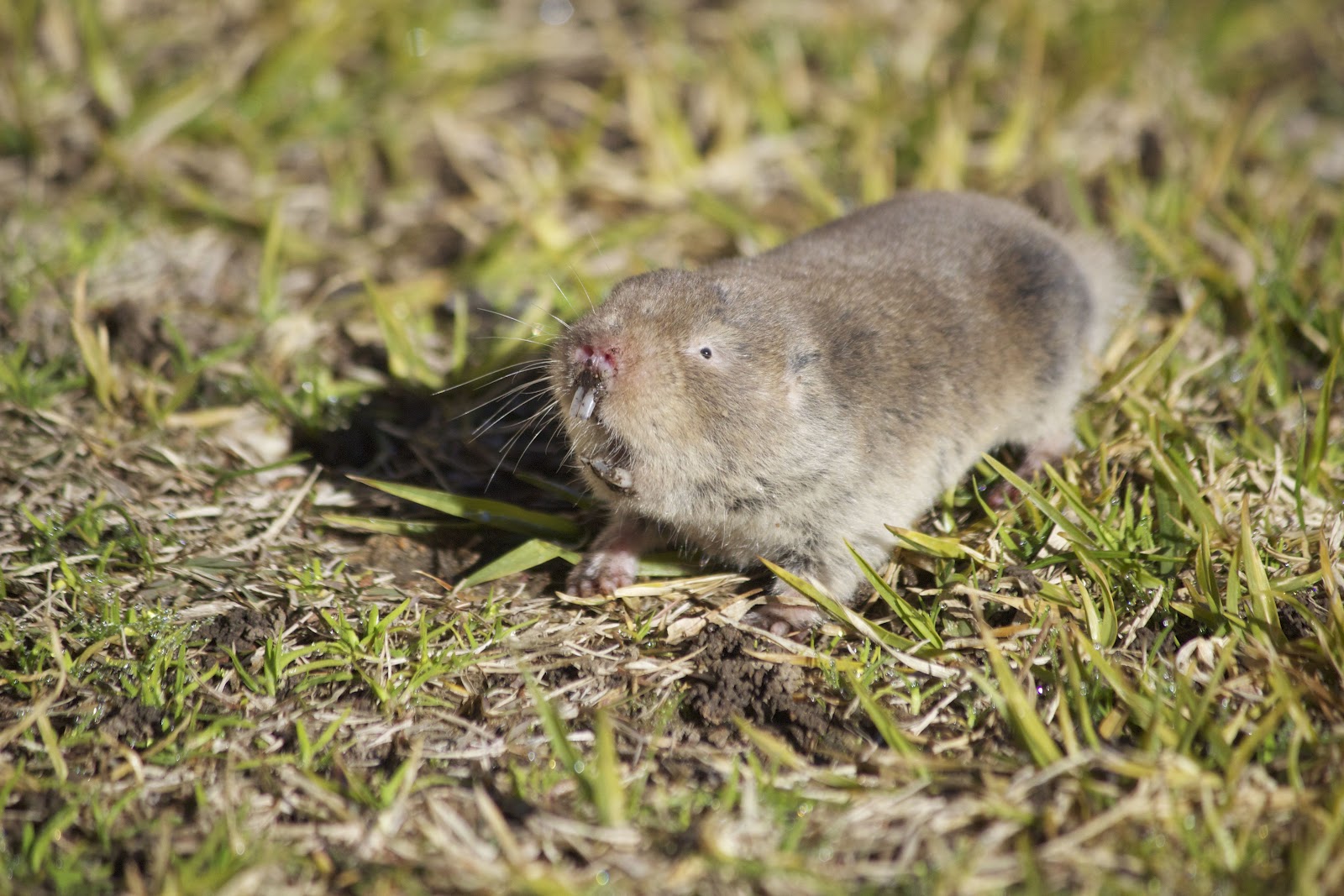
Holey Moley

Last week after the floods Chris came around carrying a bucket. He had been to check on the mud by the cottage and on the way back had found something on the driveway. The rain had washed a mole rat out of its underground system. He was a very ferocious guy challenging us with his sharp teeth. Since they live in family groups we released him back into the garden where he promptly burrowed away under a flower pot hopefully to meet up with his family again.


Monday, 30 July 2012

Otter in the Dunes

Last week I was at a series of talks about fynbos and research in the fynbos area and it was housed at Cape St Francis Resort. On one of the days there was some time allocated with no talks so I took a walk along the famous surf break on the beach at Cape St Francis. 

At the far end of the beach there are a small series of dunes that look out over Jeffries Bay and down to Port Elizabeth. While walking here I came across what at first looked like a cat running around. I then realised it was an otter, a cape clawless otter. It had not seen me as it was so intent on reaching a pool that had formed in the dunes. I dropped to my stomach in the wet sand and crawled to the edge of the pool.


I only had my medium zoom lens with me but he was so close I managed to get some rather nice photos. I watched him swimming around for a while until he disappeared into the dunes. I then realised the talks where due to begin soon and had to rush across the dunes like Lawrence of Arabia to be back in time.


Wednesday, 25 July 2012

Baboons!

Here in the mountains at Blue Hill there are plenty of baboon although they are very wary of humans due to being shot by farmers. They are very unlike the Cape Point baboons.
Using my camera-trap set right in the hills miles from the house and managed to capture some natural baboon behaviour (although I was hoping for a leopard).
Below are two videos from the camera trap followed by a few photos.


The baboons run at the first sight of people.
 Here they are keeping an eye on me.

And this guy didnt make it, maybe prey to a leopard?

Saturday, 21 July 2012

Birds of the Blue Hill

Here at the Blue Hill on the border between the Western and Eastern Capes within the Kouga and Bavianskloof area is a paradise for birders. The birds are not wary of people for some reason and allow great viewings, even from the actual house. I have collected a few of my photos so far of bird life to show you all.

I am sure that plenty more such images will follow. So here they are.

Orange breasted sunbird (male)
Cape Grassbird

Cardinal woodpecker

Juvenile Orange Breasted Sunbird

Another Male Orange breasted sunbird

Bokmakerie

Wednesday, 11 July 2012

Arrived in South Africa

Well here I am in South Africa staying at the Blue Hill Escape. I have had my camera up already and seen plenty of signs of the cape mountain leopard, spoor and scat. 

The baboons are quite a frequent sight but much more nervous than the peninsular ones. Probably due to the fact they have been hunted here and shot as vermin. I am on the bird survey at the moment having set off today with bavianskloof nature area next up. 

Birdlife is everywhere with sunbirds singing meters from where I stand. Redwing starlings, my favourite bird, nests in the roof above my room.

The location is so remote at night it is absolutely deafening with the quietness. This also has the effect that the sky at night is unbelievable which this time-lapse I created shows.


Images unfortunately will be in a future post as I have limited internet and they are all in RAW format at around 30mb each.

My camera trap has captured some nice baboon behaviour as well as some species of buck and kudu. These will be up soon.

Finally an image not in RAW for you to show the starts. 

Milky way showing the southern cross and pointers in the top right.  (30 second shutter, 3200 iso.)


Saturday, 16 June 2012

The Plan

On 25th June 2012 I leave the UK and head off for 6 months in South Africa. The purpose of the trip is to accompany Alan Lee from Blue Hills in the Bavianskloof on his research project (link). This will be for 3 months after which my family are coming over for a fortnight who I will meet up with. I will spend 2 weeks with them around Langebaan on the West Coast. My next stop is to train as a field guide with Ulovane training (link) on Amakhala (link). This will help me for my future in which I will become a field guide in South Africa.

Followers of my other blog from my time in the UK (link) will be familiar with the type of content I post. For newcomers take a look at the other blog but here is a quick round up. Expect camera trapping, photography, videos, a few rants, and any other nature or photography based content.

Being in South Africa and travelling around a bit things here should be more exciting. Stay tuned for more content soon.

Naturally I don't know how often I will be able to update here but I will do my best.